.png)
The aboveground pool demystified
.jpg)
Détecto has designed a practical guide for you to know everything about the terminology associated with the different parts and parts of a Above ground pool and to better understand the frequent problems and breakages that can occur.
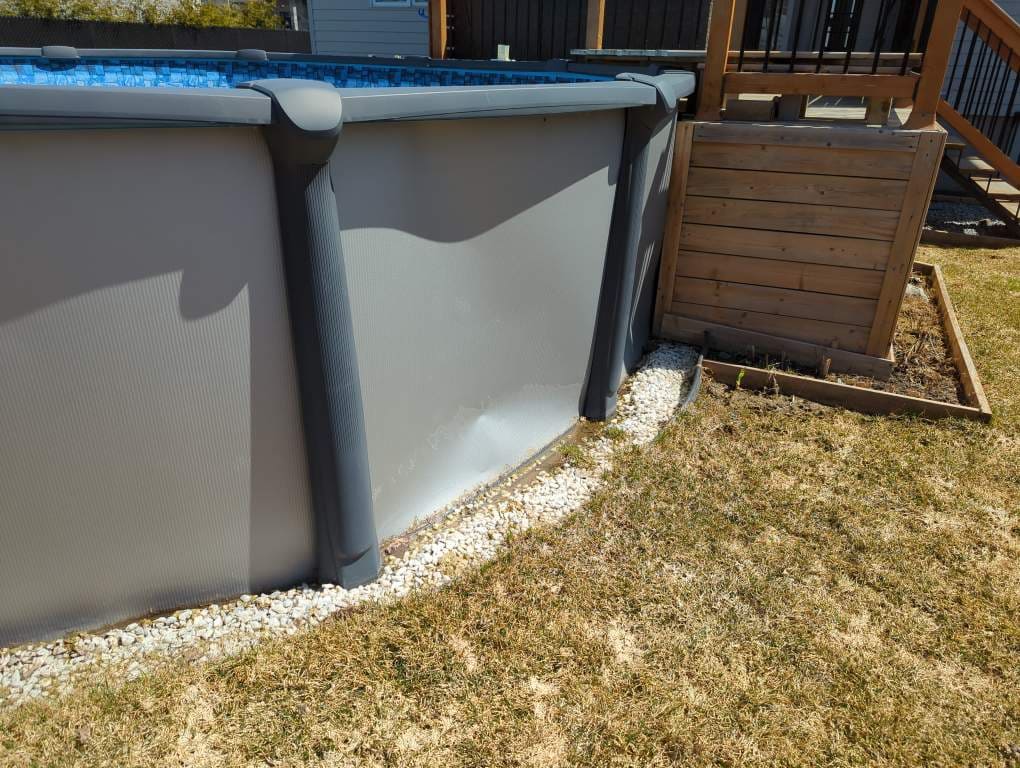
The above ground pool, with deck. Here, the pool was damaged in the skimmer; it had not been filled with styrofoam before winter.


The short history of aboveground pools
Above-ground pools have been on the Quebec landscape for decades and they haven't changed much.
Sustainability is certainly not the same as products from 20 years ago. The walls are much thinner and don't forgive mistakes easily. A bad winter or a changeable winter can more easily affect it.
Over the past ten years, some elements have evolved in terms of materials, the coping, the posts and the wall are now available in a resin version, rather than in steel, as was the norm before.
Until recently, all structures were pretty much the same and difficult to distinguish from brand to brand or year to year. Our 30 years of experience allow us to make a fairly accurate judgment, but above ground pools have no distinctive signs and it is never possible to identify their age for sure.
1. Wall
For an above ground pool, we speak of a wall because it is a piece of galvanized steel made in one piece. Contrary to some beliefs, it is not stainless steel so its corrosion resistance is very limited.
When chlorinated pool water comes into contact with the wall, it will cause it to rust. This is also the biggest safety issue with aboveground pools, sometimes a small leak is not visible and the flow of water allows corrosion to set up between the liner and the wall.
When you see rust appearing on the outside of the wall, it is already too late; you have to dismantle the pool as soon as possible because the risks of the wall opening spontaneously are then significant. The area of the wall that tears will show a very sharp edge (like a tin can) and the risks of an injury to a bather will be very real.
2. Liner
Vinyl liner has a limited lifespan, it dries in the sun and is fragile during the winter. For a few years, pool builders offered canvases of various thicknesses and qualities but this is no longer the norm. Today, all canvases are the same.
During the winter, if the liner is pierced, the mass of ice that rests on the water will fall heavily to the bottom of the pool and deform the walls; it is important that the pool is well watertight when it is closed for the winter.
Our experts can recognize the signs of wear and tear and those associated with an accidental event. Also, during each evaluation, we assess the age of the canvas and the pool, and provide an average depreciation based on the estimated lifespan in our report.
3. Top rails and uprights
The border is what some would call the “edge” of the above ground pool. Although it is a few inches wide, you should not walk on it as it may damage the wall.
In recent years, the new standard has been to have a resin border and posts — this does not give any particular advantage, especially since these elements play a poorly functional role; the posts serve as support for the border, but the wall is self-supporting. However, the purchase price is higher for the resin option.
4. Skimmer
It's the plastic mouth that collects surface water and floating debris for treatment by the filtration system. It is not uncommon for some users to forget to fill the skimmer with styrofoam before winter and this causes the wall to break because the engulfed ice will want to follow the melting mass inside the pool.
5. Return jet
It is the plastic nozzle that is located below the normal water level and returns filtered (and sometimes heated) water back into the pool. The return must also be well corked for the entire period of its hibernation.
6. Main drain
Not all above ground pools are sold with a main drain. This makes pool maintenance a lot easier, but winter preparation must be done carefully to avoid major damage — sometimes total loss.
7. Filtration system
Polyethylene and/or PVC pipes connect the skimmer, the return jets, and the main drain to the pump and the filter (which are generally located nearby at a minimum distance of 1 m, as required by law).
The pump circulates the water, the filter collects the debris and the water heater heats the water!
When there is a main drain, water can flow up the pipe during warmer periods of winter. It is essential to prevent water from leaking and the ice mass in the pool from falling to the bottom. Its sharp surface would break the canvas and the structure would deform under force.
It is therefore necessary to take into account the phenomenon of communicating vessels and extend the bottom drain pipe to the maximum height that the water could reach in the pool, i.e. up to the border. Many aboveground pool owners neglect this step, which can unfortunately cause significant damage.
These three elements of the filtration system should also be properly prepared for winter. Many owners use a pool technician to close and open their above ground pool, but these steps can also be done quite easily by the owner.
Have you received a quote for work? Send it to us, and we will help you validate its relevance and budget.
8. Removable ladder
To access the above ground pool, a removable ladder must be used. The removable ladder should not be left in the pool during the winter and its handling must be very careful to avoid damage to the canvas during installation or removal.
.jpg)
At Détecto, our expertise in pool inspection has been built over the past 30 years. With more than 15,000 pools inspected, our team brings a sharp eye and an accurate assessment of your pool’s true condition.
Our neutrality is what truly sets us apart. We do not sell pools or equipment, which allows us to provide objective evaluations and tailored recommendations — with no conflict of interest.
Whatever your situation, do not hesitate to contact us. We will be happy to help you better understand your pool and make informed decisions.

.svg)